What is review cadence? A guide for Data and AI pilots
- Published 11 Feb 2026
- Last updated 26 Oct 2026
- In Blog, Delivery
- ~8 min read
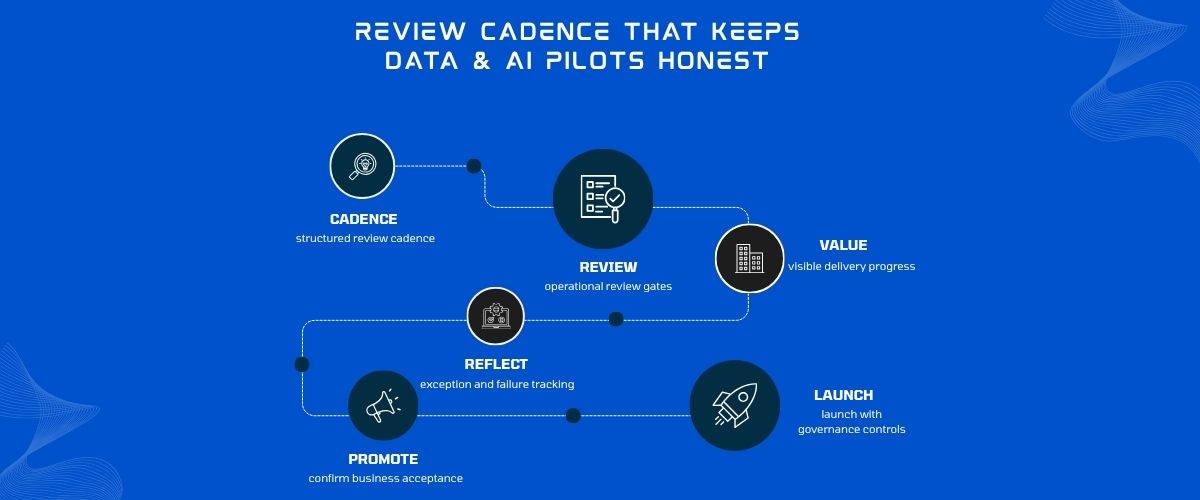
Review cadence is the fixed rhythm (usually weekly or fortnightly) at which a pilot team demos real progress on real data, records exceptions from the last cycle, and updates what “done” means so sponsors see runnable work in a named environment. It keeps Data and AI pilots visible to operations and leadership between kick-off and go-live.
Who this guide is for
Operational sponsors, finance and ops leads, and delivery teams running a bounded pilot in an Australian SME. If stakeholders only see the programme at go-live, use this rhythm to surface evidence earlier. For how often to meet, see our FAQ on pilot review frequency.
Weekly or fortnightly: pick a real slot
Fortnightly suits mature teams with stable dependencies. Lock a 45-minute slot in the calendar and keep it. If the slot is empty twice in a row, treat that as a delivery risk: the work may be too large, access may be blocked, or dependencies need to be named before the next cycle.
What belongs on the agenda
- One piece of value: for example triage for five ticket types, internal FAQs with citations, or a nightly sync with conflict rules written down.
- Exceptions in plain sight: the top three failure modes from the last week, such as missing fields, ambiguous policy text, or auth edge cases.
- Audit trail: for anything that writes to CRM or sends mail, show what was decided, which rule applied, and what a human can override.
Clear sign-off each cycle
Each step ships with five to ten checkboxes a business owner can tick: inputs, outputs, error handling, and who gets notified. New ideas go to a backlog with a rough size before they displace the current work. That keeps scope honest while still capturing good feedback from the floor.
Who needs a seat
The core trio is an operational sponsor who can say no, a technical lead, and someone who lives the workflow daily. Rotate compliance or IT security when access, retention, or logging is on the table. They do not need to attend every week unless those topics are active.
How data refresh fits the same programme
Delivery review cadence is about what the team shows you. Data refresh rhythm is how often feeds update and quality checks run so demos reflect production-shaped data. Align both before you widen automation. Clean CRM noise first with duplicate contact cleanup.
Leadership should see runnable evidence on a rhythm you can name, not only at go-live.
Red flags
- Demos that only work on a developer laptop or anonymised toy data.
- No shared staging setup that mirrors production permissions.
- Success defined only as model accuracy without a business outcome metric.
How a Yarli project runs
Start with a free 30-min workflow call. If there is a fit, paid discovery maps one stuck workflow and a fixed proposal. Delivery uses a named review rhythm, clear sign-off, and staging that mirrors real access. Your team still approves anything that goes to a customer. Full path: how an automation project works.
See business workflow automation, pricing, or book discovery.
If you are ready to automate a workflow
When the review rhythm is clear and one stuck path is named, start with business workflow automation, browse services, or check pricing. Common first workflows include quote automation, CRM cleanup, and reporting automation.
Published by Yarli Data, Sydney. Australia-wide delivery for operational AI and workflow automation.
Design your review rhythm
Tell us about stakeholders and systems — we will propose a cadence, environments, and acceptance pattern that fits your pilot.